 Darija Pro
How do you understand a darija message from your family?
Read it word by word, not sentence by sentence. A darija message is a string of short words that come back often: salam (hi), wldi (my son), wach (is it that), nta (you), labas (fine). Once you recognise those, the meaning appears on its own. That is what Translate does: it cuts the message into cards, one word per card, on your phone. And if you want to answer, it offers three replies, each with its voice.

Decode a message and answer it with the app
- Copy the message. In Messages or WhatsApp, copy the text you don't understand. On the app's home, the card “Got a message? Paste it” detects it and offers to decode it in one tap.
- Read the cards. One card per recognised word: the word, its Arabic script, its meaning, and its voice. This step happens on your phone, with no network.
- Understand the sentence. Tap “Understand the sentence”: the app explains the tone and the intent. For that, the sentence goes to the language model, then the answer is checked word by word against the dictionary.
- Reply. Tap “Reply”: three replies in darija, with the Arabic script, the meaning, and a disc to hear them. You copy the one that sounds like you.
An example: the morning message
sba7 lkhir, la bas? Two words, one question: good morning, are you well? Translate offers three replies. sba7 nnor, la bas l7amdolillah, w nta ki dayer? Good morning to you, fine thank God, and how are you? Or shorter: sba7 lkhir, kulchi bikhir l7amdolillah. Good morning, all is well thank God. Under each reply, one line gives the tone: reassure warmly and ask for news in return.
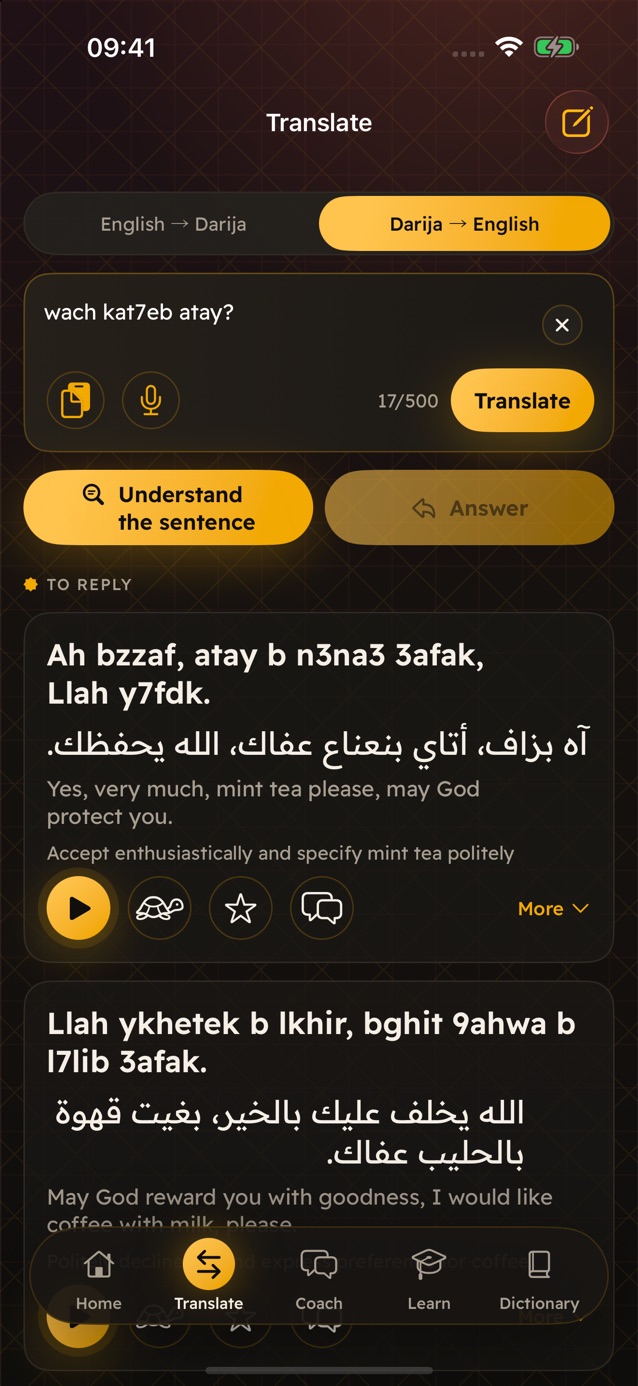
The words that come back in every message
A handful of words opens most family messages. salam and labas for greetings. wach to ask a question. aji and jib for requests. ghadi for what is about to happen. nhar for the day, dar for the house. Learn those and you already understand half a message before decoding it.
Why cards rather than a one-block translation
A one-block translation gives you an English sentence and leaves you as lost as before. Cards show you each word, so next time you recognise it yourself. The decoding looks up each word in our dictionary, written by Moroccans, and shows you the entry. When a word is missing, the card offers to request it.
What stays on your phone, and what leaves it
The word-by-word cards are computed on the device, with no network. “Understand the sentence” and “Reply” send the sentence to the language model to get the answer, with no identifier that points to you, and nothing is stored on our side. The privacy policy details what leaves and when.
Questions about this guide
Does Translate understand messages in Arabic letters?
Yes. The dictionary search works in Arabic letters as in arabizi, and the decoding relies on the same search.
What happens if a word is not in the dictionary?
The card offers “Request it”. The word goes out by email, we read it, and it enters the dictionary with the next update.